Signal Iduna Park and the Yellow Wall
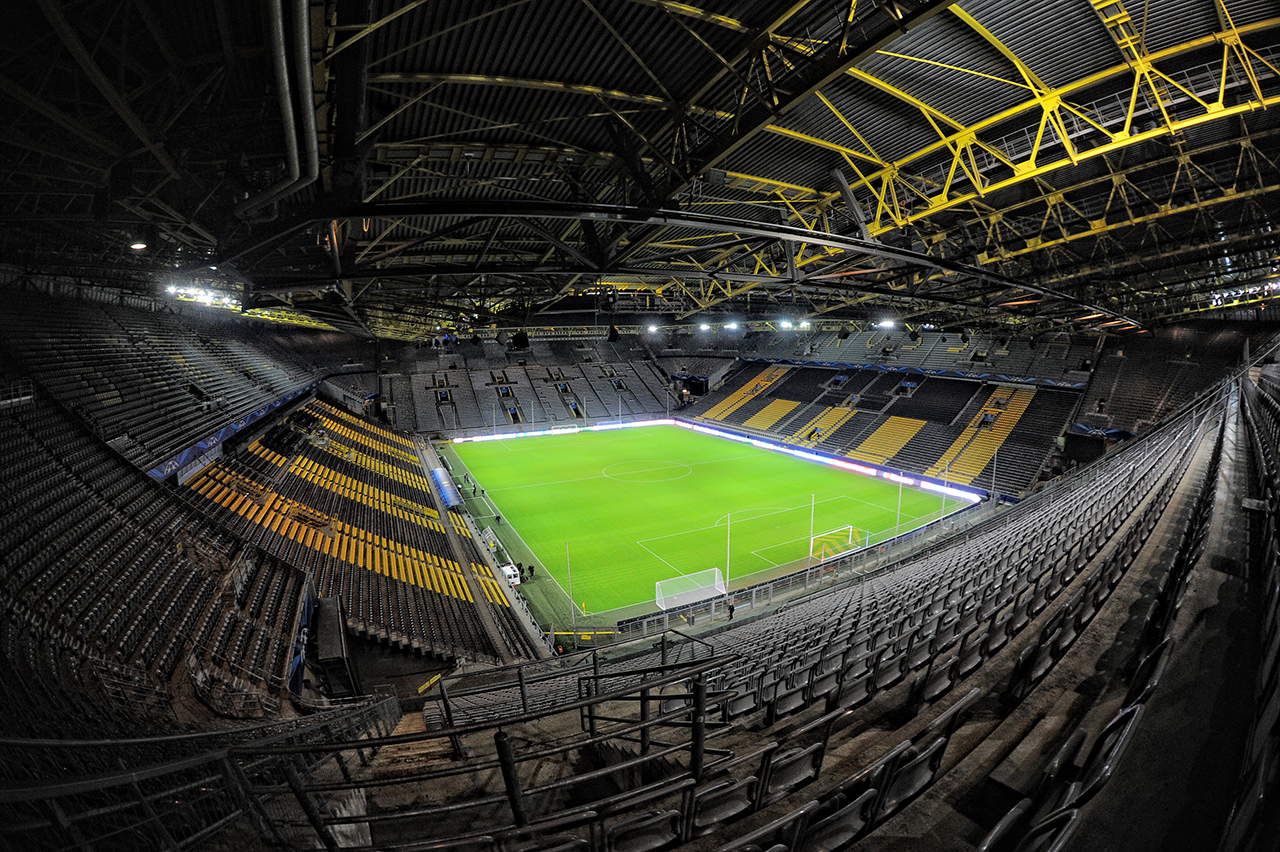
If you want to understand why German football is famous for its atmosphere, look no further than Signal Iduna Park — the home of Borussia Dortmund and the site of the most famous stand in the world, the "Yellow Wall." With the largest standing terrace in football and one of the highest average attendances anywhere, it is a stadium built around the idea that supporters should be loud, close and standing. This guide covers its history, its iconic terrace, and how to recognise it in footbadle's Stadium Spotter.
History of the Westfalenstadion
The stadium opened in 1974, originally named the Westfalenstadion after the Westphalia region, and built when West Germany hosted the World Cup. Many fans still affectionately use the old name, though it has carried the Signal Iduna Park sponsorship name for years. It was expanded several times, growing into a roughly 81,000-capacity colossus — the largest stadium in Germany.
It has hosted World Cup matches, European finals and countless famous Dortmund nights. The combination of a huge capacity, cheap standing tickets and a passionate fan culture has made it one of the best-attended club grounds on the planet.
The Yellow Wall
The stadium's defining feature is the Südtribüne — the South Stand — known across football as the "Yellow Wall." It is the largest free-standing terrace in world football, holding around 25,000 standing supporters in a single steep bank behind one goal. On match days it becomes a vast, swaying sea of yellow and black, with enormous choreographed tifo displays. The sight and sound of the Yellow Wall in full voice is one of the modern game's great spectacles.
Standing terraces of this size are largely unique to German football, which retained safe standing areas when many countries moved to all-seater stadiums. That makes the Yellow Wall not just Dortmund's signature, but a symbol of German fan culture as a whole.
Other defining features
- The yellow pylons — distinctive yellow support pylons stand at the corners outside the stadium, holding up the roof structure, and are visible from a distance.
- Yellow and black everywhere — Dortmund's colours saturate the ground.
- The four separate, steep stands — rather than a single continuous bowl, the ground is built as four huge, close, steep stands, maximising noise and intimidation.
Recognising the Westfalenstadion at a glance
To identify Signal Iduna Park:
- The vast single-tier terrace behind one goal — if you see one enormous, steep, yellow standing bank dwarfing the other stands, it is the Yellow Wall.
- Yellow and black seating and tifo.
- The yellow exterior pylons in wider or exterior shots.
- A German setting and a capacity hint around 81,000 — the largest in Germany — which helps confirm it.
A model for fan-first football
Signal Iduna Park is more than a great atmosphere; it is the showpiece of a whole approach to running football. German clubs, shaped by member ownership under the 50+1 rule and the country's footballing culture, kept ticket prices affordable and retained safe standing when many countries removed it. The Yellow Wall is the spectacular result: a vast terrace where tens of thousands of supporters stand, sing and choreograph displays match after match, for a fraction of the cost of a seat in some other leagues.
That accessibility feeds the intensity. Because going to the match is affordable and the standing areas put supporters close together and close to the pitch, the ground fills with a young, loud, committed crowd every week, producing some of the highest average attendances in world football. Visiting teams have to contend not just with a good side but with an environment engineered, by design and by culture, to be as hostile and as loud as possible. For many neutrals, watching a match in front of the Yellow Wall is one of the essential experiences in football — proof that the supporters can be as much a part of a stadium's greatness as its architecture.
What the Yellow Wall teaches you
Signal Iduna Park is the clearest example of a footballing philosophy: that atmosphere is built by putting as many passionate supporters as close to the pitch as possible, standing and singing. The Yellow Wall has become a destination in itself, something neutrals travel to experience — and when Dortmund host Schalke in the Revierderby, it becomes the backdrop to one of Europe's most intense fixtures.
It is also one of the most distinctive grounds to learn, because nothing else has a terrace on that scale. Once you can recognise the Yellow Wall, Signal Iduna Park becomes one of the quickest solves in Stadium Spotter — and a reminder that the world's great stadiums are defined as much by their supporters as their architecture.
See if you can spot football's most famous terrace — play today's Stadium Spotter.